ANDROID HISTORY
In Part 1 of our 8-part series on the History of Android, we look at the humble origins of what has grown into the most popular mobile operating system in the world.
Android didn't just happen. The origins of the world's dominant mobile operating system can be traced right back to the beginning of the previous decade, through the work of founder Andy Rubin, and Google, which was eager to establish itself as a major player in the mobile future.
In the first part of our Android History series, we look back on the earliest origins of the OS, the path to launching the original Android phone, the T-Mobile G1, and some of the influences that shaped Android's early days. And we'll take a rare look at one of the early Android prototypes that never saw the light of day.
The mobile world, circa 2006

In the world of technology in general, and mobile technology in particular, the mid-2000s now seems like ancient history.
The rumored iPhone was actively denied by Apple. Netbooks were the hot new category of ultraportable computing device. The tablets of the day looked like your clunky work laptop with the keyboard chopped off. There was no Twitter. YouTube was a scrappy startup. Windows Vista was a thing.
The smartphones of the time were, by modern standards, slow, clunky and ugly — a landscape dominated by Symbian, Windows Mobile and BlackBerry where productivity was king. Though the idea of a phone being more than just a phone was steadily gaining traction, the concept of a mainstream smartphone remained something of an oxymoron.
The smartphones of the mid-2000s weren't just basic from a technological standpoint, they were a minefield for developers, and in many markets mired in carrier restrictions — far more than what we endure today. User experience and ease of development came second to competing corporate interests — in contrast to the relatively open world of PC and web development.
That's the background against which Android — now the world's most popular mobile OS — was conceived. And as we'll discover through this series, Android's openness — though not without its foibles — allowed it to gain traction against the closed competition.
Andy Rubin and Danger

Several years before Android existed, there was a small mobile software company called Danger, founded by veteran Apple engineer Andy Rubin.
The one huge claim to fame Danger had was the Hiptop, a smartphone with a landscape keyboard and software that made instant messaging, web browsing, and email equally important in the interface.
Through a partnership with T-Mobile, Danger rebranded the Hiptop to Sidekick, and the cult following that brand gained was unique for its time.
Danger's services, rather than the hardware itself, was the product being sold
What made Danger's Sidekick so successful was a revenue-sharing business model that, at the time, was wildly different from the standard mobile business model.
Danger's services, rather than the hardware itself, was the product being sold. By selling the hardware dangerously close to cost and sharing service revenue with T-Mobile, Sidekicks were able to create a niche that competed directly with Blackberry and Microsoft in the smartphone space.
Google's Larry Page and Sergey Brin soon were spotted rocking Sidekicks everywhere they went — after all, what could be better than being able to use Google Search no matter where you were? Then Danger's board of directors voted to replace Andy Rubin. Using a domain name he'd owned for a while already, Rubin formed a new company focused on developing a platform that was open to all software designers.
Android, Inc.
Android, Inc. was a standalone software company with no product to sell for two years. During most of this time, Rubin basically funded the company himself. With a small team of software engineers and a plan to make the next generation of smartphone software, the company focused on an open-source evolution of many of the ideas that started at Danger.
By focusing on the best web-connected experience they could, and creating an environment any developer could build on, Android had a solid plan that investors quickly jumped on when it was finally pitched to them in 2005. While plenty of investors were looking to get in on this next-gen mobile experience, Google found itself in need of a smartphone company to compete with Microsoft and Blackberry. Page and Brin wanted more phones with Google as the default search engine, and an open platform like Android offered a great way to accomplish exactly that.
Page and Brin wanted more phones with Google as the default search engine.
By the end of 2005, Rubin and his team were set up in offices in Mountain View, Calif., hidden away from the world, while they worked with this new company to finish this combined vision.
Prototypes: The road from Sooner to the G1
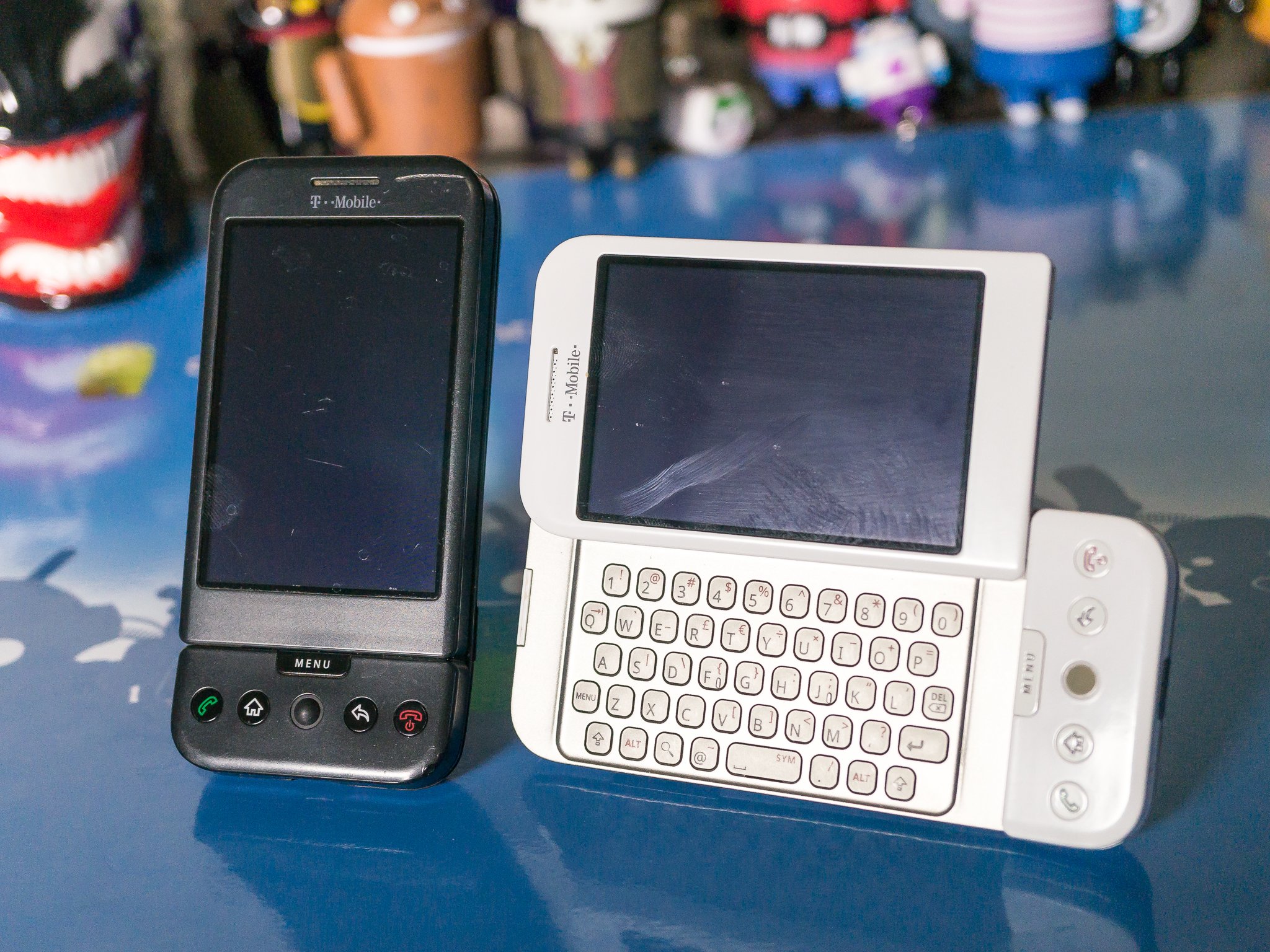
But software is nothing without hardware. And while many will remember the T-Mobile G1 as the first Android phone, sporting a QWERTY slider design and a large (for the time) touchscreen, this was just one of many designs under consideration by Google and manufacturer partner HTC, which for many years lived as a nameless ODM.
The HTC-built 'Sooner' looked more like the BlackBerry devices of the time.
The best-known prototype handset was known by the codename "Sooner." The HTC-built slab looked more like the BlackBerry devices of the time than the touch-focused designs to come, with a full QWERTY keyboard below a 320x240 display.
HTC Europe's Product and Services Director, Graham Wheeler, told Android Central that the partnership with Google consisted of these two main designs, and that for HTC and its device testers Android represented a drastic change from the Windows Mobile-based smartphones of the time. "There were two different IDs — a QWERTY keyboard design, and then the G1 as well. So we were looking at them both," Wheeler says. "It was a different OS and had a very different paradigm to Windows Mobile at the time, which was much more tech-savvy."
Reflecting on HTC's history with Windows Mobile in the mid-2000s, HTC America President Jason Mackenzie told AC, "If you go back to that time it was actually a big risk that HTC took. And at that time Microsoft and Google weren't exactly the best of friends."
"At that time, even with the momentum that Apple was generating with iPhone, there were people who said 'I need a keyboard.'"
The company's CEO also played a key role in getting HTC in on the ground floor with Android, Mackenzie explains. "Peter Chou had a good relationship with Andy Rubin going back to when he was at Danger. So they talked, and what we were really excited about was a platform that was Internet-based and giving consumers an opportunity to put the Internet in their pockets."

"It was a time when [consumers] weren't all comfortable with an all-touch screen. Even with the momentum that Apple was generating with iPhone, there were people who said 'I need a keyboard.' RIM was still a successful company at that time. So I think both parties saw an opportunity — let's enable a strong touch interface that delivers the Internet, puts that in people's pocket — but that's kind of a gateway to this new touch thing."
It would've been difficult for anyone to predict the meteoric rise that Android would eventually enjoy, but Mackenzie remembers plenty of buzz around the G1 from within HTC prior to launch.
"We were excited to really, really break the chains from our engineers."
"I can remember being super-excited about it. We knew it was going to be big. [Google] were all-in behind it. I think we knew it had the potential given their experience with the Internet, given the platform and the roots of it and the freedom that we had as a manufacturer to drive innovation in the platform. Because as good a partner as Microsoft was and is, Google's strategy was much different in the sense that 'OK, we're giving you a platform and you can go innovate. We want you — HTC — to innovate.'"
"We were excited to really, really break the chains from our engineers."



No comments:
Post a Comment